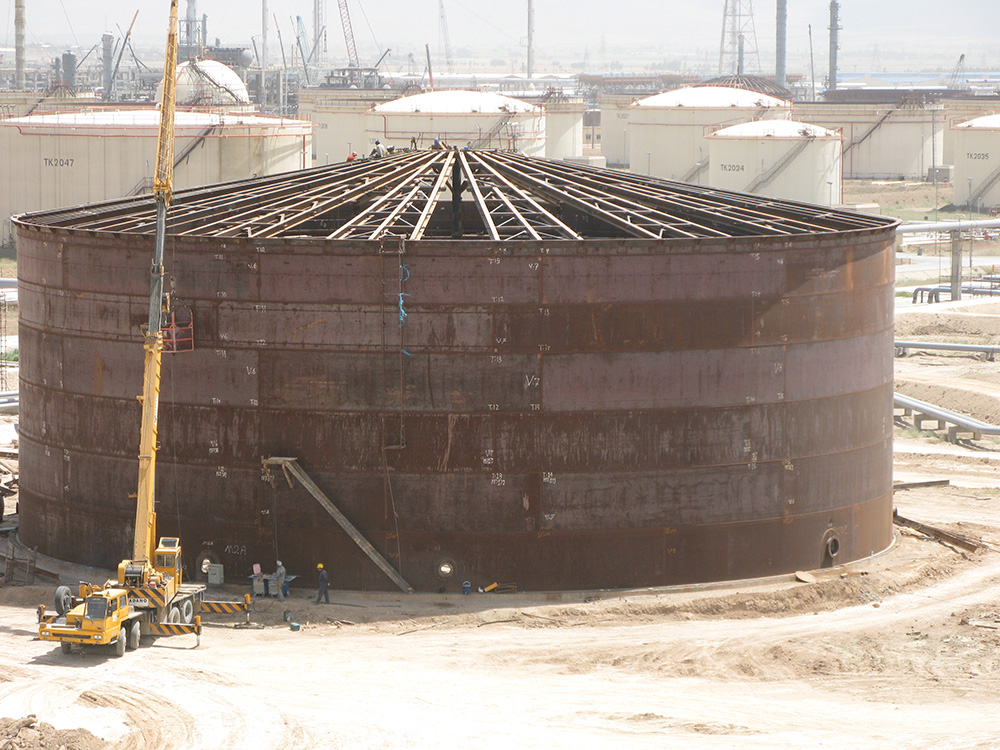

In many industrial projects—from refineries and petrochemical plants to food and chemical industries—the correct selection of a storage tank is one of the key decisions during the design and execution phases. Atmospheric cylindrical tanks, due to their simple structure, reasonable fabrication cost, and suitability for large volumes, are among the most widely used types of storage tanks. However, improper selection of this type of tank can lead to reduced equipment life, increased maintenance costs, and even safety hazards.
This article practically reviews the most important technical and execution-related factors that should be considered when selecting a cylindrical tank, particularly atmospheric cylindrical storage tanks.
What Is an Atmospheric Cylindrical Tank?
An atmospheric cylindrical tank is a tank designed to store fluids at pressures close to ambient pressure. These tanks are commonly used for storing liquids such as crude oil, petroleum products, water, chemicals, and industrial fluids.
In this type of tank, the internal pressure is mainly generated by the hydrostatic head of the stored liquid, and pressure above the atmospheric range is not considered. This characteristic makes the design, fabrication, and operation of atmospheric storage tanks simpler and more economical compared to pressure vessels.

Importance of Proper Selection of Atmospheric Cylindrical Tanks
Selecting a suitable storage tank is not limited to capacity and dimensions alone. Process conditions, type of fluid, operating temperature, environmental conditions, and safety requirements all play decisive roles. A proper selection results in:
- Increased operational safety
- Reduced maintenance and repair costs
- Extended service life of the tank
- Full compliance with industrial standards
Therefore, in industrial projects, the selection of atmospheric cylindrical tanks should be based on technical analysis and engineering experience.
Evaluation of the Stored Fluid
One of the first steps in selecting a cylindrical tank is a thorough understanding of the fluid to be stored. Properties such as corrosiveness, temperature, viscosity, and flammability have a direct impact on tank design.
For example, storing corrosive materials requires the use of more resistant materials and consideration of corrosion allowance. In contrast, for non-corrosive fluids, conventional carbon steels can be used, reducing fabrication costs. This issue is particularly important in atmospheric cylindrical tanks due to the large contact area between the fluid and the tank shell.
Capacity and Dimensions of the Cylindrical Tank
Storage capacity is one of the main parameters in selecting a cylindrical tank. Capacity should be determined based on actual process requirements, operating conditions, and future expansion plans.
Increasing the diameter or height of the tank changes the stress distribution in the shell and directly affects plate thickness and foundation design. In atmospheric cylindrical tanks, increasing the diameter is generally preferred over increasing the height, as it provides better structural stability.

Role of Standards in Storage Tank Selection
In the design and fabrication of atmospheric cylindrical tanks, compliance with recognized international standards is essential. These standards provide clear guidelines for shell thickness, welding methods, testing, and safety requirements.
API 650 is one of the most important references for the design of atmospheric storage tanks and is widely used in the oil, gas, and petrochemical industries. Selecting a tank designed and fabricated in accordance with this standard significantly reduces operational risks.
Selection of Roof Type for Cylindrical Tanks
The tank roof is one of the key components affecting the performance and safety of cylindrical tanks. Depending on the type of fluid and environmental conditions, either fixed roofs or floating roofs can be used.
For storage of volatile liquids, floating roofs help reduce evaporation losses and vapor emissions. In contrast, for many atmospheric cylindrical tanks containing low-volatility fluids, fixed roofs are an economical and practical option. Roof selection should be made with consideration of safety, environmental, and cost requirements.
Shell Thickness and Corrosion Considerations
The shell thickness of a cylindrical tank must be selected to withstand hydrostatic pressure of the stored fluid, environmental loads, and long-term corrosion effects.
In industrial projects, the calculated thickness is usually increased by a specified corrosion allowance to compensate for thickness loss over time. This consideration is especially important for atmospheric cylindrical tanks with long design lives.
Environmental Conditions and Installation Location
Climatic conditions at the installation site—such as temperature, humidity, wind, and seismic activity—affect the selection of cylindrical tanks. In hot or humid regions, corrosion protection and appropriate coatings become even more critical.
Additionally, tank foundation design must be compatible with soil conditions and tank weight to prevent uneven settlement. In many projects, inadequate foundation performance has led to additional stresses in storage tank shells.

Operation and Maintenance Considerations
A suitable cylindrical tank should be designed to allow easy inspection, maintenance, and repair. Providing manways, properly located nozzles, and safe access routes plays a significant role in reducing operational costs.
For atmospheric cylindrical tanks, planning for periodic inspections and shell thickness monitoring is an integral part of safe operation.
Conclusion
Selecting an atmospheric cylindrical tank is not merely a dimensional or financial decision, but an engineering process that must consider the type of fluid, required capacity, environmental conditions, design standards, and operational requirements.
Adhering to these considerations ensures that storage tanks are not only safe in operation but also economically optimized, imposing minimal maintenance costs throughout their service life. Experience shows that informed selection of atmospheric cylindrical tanks plays a crucial role in the sustainability and success of industrial projects.
References