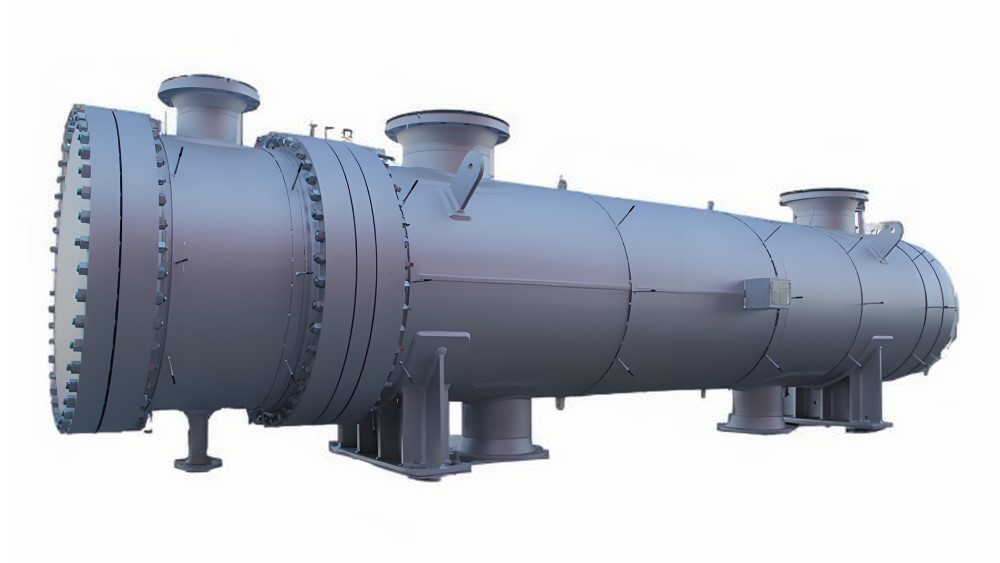
Heat exchangers are among the most important industrial equipment used to transfer heat between different fluids. Optimal performance of these devices requires a precise understanding of the fundamental principles and concepts related to heat and heat transfer. Familiarity with common definitions and terminology helps engineers design, maintain, and operate heat exchangers more safely and efficiently. This article provides a comprehensive review of common terms related to heat exchangers in refineries and helps readers gain a more accurate and practical understanding of how these units operate.
Sensible and Latent Heat
Sensible Heat: Sensible heat is the amount of thermal energy required to change the temperature of a substance within a single phase. This energy increases or decreases the temperature of the material without causing a phase change and is usually equal to the change in enthalpy of the substance in the single-phase state.
For example, heating water from 20 °C to 50 °C is an instance of sensible heat transfer. This concept is important in heat exchanger design because the calculation of outlet fluid temperature directly depends on sensible heat.
Latent Heat: Latent heat is the energy required for a substance to change phase without a change in temperature.
For instance, converting water into steam or ice into water requires the absorption of latent heat. In heat exchangers, processes such as evaporation and condensation require accurate calculation of latent heat to ensure the correct selection of exchanger size and type.
Evaporation and Condensation
Evaporation: Evaporation is the process in which a substance changes from the liquid phase to the vapor phase by absorbing thermal energy. This process plays a key role in heat exchangers, especially in chemical and power generation industries where steam is used as an energy carrier.
Condensation: Condensation is the reverse process of evaporation, in which vapor changes into liquid and releases thermal energy.
For example, in power plants, condensers convert turbine exhaust steam into liquid so it can be reused in the power generation cycle. In exchanger design, careful attention to condensation temperature and pressure is essential to achieve optimal thermal efficiency.
Thermal Sources
Thermal sources include hot and cold streams used to control the temperature of process fluids:
- Hot stream: A fluid or energy stream that must lose heat and cool down from a higher temperature to a lower one, such as hot water or high-pressure steam.
- Cold stream: A fluid that gains energy and is heated from a lower temperature to a higher one, such as cooling water in industrial heat exchangers.
Accurate identification of thermal sources helps engineers properly select the exchanger type, tube material, and heat transfer surface area, thereby minimizing energy losses.
Saturation State
The saturation state refers to conditions under which liquid and vapor phases coexist in equilibrium at a constant temperature and pressure.
- Saturated vapor: Vapor that is about to form the first liquid droplet, indicating the onset of condensation.
- Saturated liquid: Liquid that is about to form the first vapor bubble, representing the onset of evaporation.
In heat exchanger design, attention to saturation conditions is crucial, as the temperature difference between the two fluids must be adjusted to ensure evaporation or condensation occurs at maximum efficiency.
Heat Transfer
Heat transfer is the process by which energy moves from a region of higher temperature to a region of lower temperature. This process is fundamental in heat exchangers and occurs through three main mechanisms: conduction, convection, and radiation.
- Conduction Heat Transfer: In conduction, energy is transferred through collisions between atoms and molecules within a material. This mechanism mainly occurs in the solid walls of heat exchangers, and material properties and wall thickness have a direct effect on the rate of heat transfer.
- Convection Heat Transfer: Convection heat transfer occurs in fluids and depends on fluid motion and mixing of hot and cold streams. This mechanism is particularly important in shell and tube heat exchangers and plate heat exchangers, as fluid flow characteristics determine the convective heat transfer coefficient.
- Radiation Heat Transfer: Radiation heat transfer occurs through the emission of electromagnetic waves from a hot source to another body and becomes significant at very high temperatures. In industries such as metal melting or thermal power plants, radiation may account for a portion of the total heat transfer.
Heat Transfer Coefficients
Thermal Conductivity: Thermal conductivity is a thermophysical property of a material that indicates its resistance to heat flow. Material type, chemical composition, and physical state directly affect thermal conductivity.
Convective Heat Transfer Coefficient: This coefficient represents the ratio of the heat transferred to the temperature difference between two heat-exchanging surfaces. It depends on flow conditions, fluid physical properties, geometry, and the dimensions of the heat transfer surface.
Overall Heat Transfer Coefficient: The overall heat transfer coefficient is the inverse of the sum of all thermal resistances between two heat-exchanging surfaces per unit area. It is one of the most important parameters in determining exchanger performance, and the exchanger size and type must be selected to optimize this coefficient.
For example, if the overall heat transfer coefficient is low, a larger heat transfer surface area is required to achieve the same heat duty, which increases the construction and maintenance costs of the exchanger.
Conclusion
Understanding the fundamental terminology of heat exchangers—including sensible and latent heat, evaporation and condensation, saturation conditions, and heat transfer coefficients—is essential for the optimal design and operation of heat exchangers in refineries. These concepts enable engineers to accurately select the type of heat exchanger, heat transfer surface area, and operating conditions to maximize energy efficiency. Moreover, proper consideration of heat transfer mechanisms and associated coefficients helps prevent energy losses and enhances the safety and efficiency of industrial processes. Ultimately, practical familiarity with these concepts provides a solid foundation for engineering decision-making and the maintenance of high-performance, cost-effective heat exchangers.