
Shell and tube heat exchangers hold special importance due to their widespread use in various industries and processes requiring heat transfer, such as oil, gas, and petrochemical industries. With their engineered structure and flexible design, these exchangers have become one of the most reliable and efficient heat exchanger systems over time. Below, we will examine their functioning, components, applications, construction, and maintenance to provide a comprehensive understanding of their features and capabilities.
What is a Shell and Tube Heat Exchanger?
A shell and tube heat exchanger is a system consisting of a cylindrical shell and a set of tubes designed to exchange heat between two fluids. These fluids, which can be gases or liquids, flow through separate pathways, exchanging heat without mixing. The tubes act as a boundary, preventing the fluids from mixing and enabling effective heat transfer.
The simple yet effective design of these exchangers allows them to perform efficiently even under high pressure and temperature conditions. Depending on the type of fluid, the tubes and shell are made from materials resistant to corrosion and pressure, such as stainless steel or specialized alloys.

How Does a Shell and Tube Heat Exchanger Work?
The operation of these exchangers is based on transferring heat from one fluid to another. The hot fluid flows through the tubes while the cold fluid flows through the shell in either a parallel or countercurrent direction. The temperature difference between the two fluids facilitates the transfer of heat energy from the hot fluid to the cold fluid.
An essential aspect of their performance is the design of the baffles, which guide the fluid flow within the shell, creating turbulence that enhances heat transfer between the two fluids. Depending on the application, the fluid flow can be single-pass or multi-pass.
To optimize performance and achieve the required efficiency, engineers use thermal simulation and analysis software to predict heat transfer and fluid flow for specific cases.
Main Components of a Shell and Tube Heat Exchanger
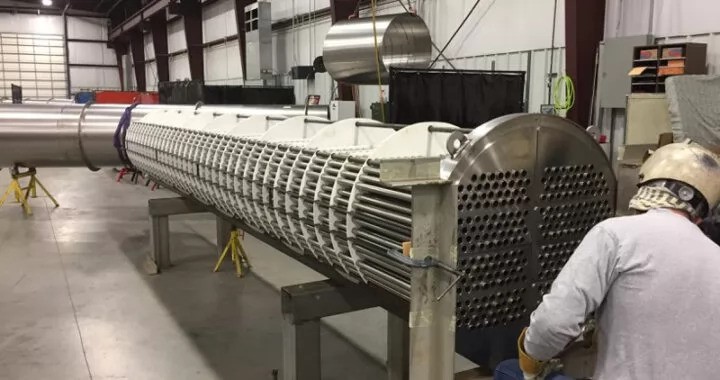
Shell and tube heat exchangers generally consist of five main components: the shell, tubes, tube sheets, baffles, and heads.
Shell: The shell serves as the main body of the exchanger, where the cold or hot fluid flows. It is typically made of metals resistant to temperature and pressure, such as steel or nickel alloys. The size and diameter of the shell depend on the number of tubes and the heat transfer process.
Tubes: The internal tubes are the pathways for the primary fluid and are usually made of materials with high resistance to corrosion and heat. Depending on the application, the tubes can be smooth or enhanced with fins to increase the surface area for heat transfer.
Tube Sheets: These metal sheets provide structural integrity to the tubes at both ends and prevent fluid leakage. The tubes are meticulously welded to the tube sheets to ensure a tight seal.
Baffles: Baffles optimize the flow of fluid within the shell, increasing the heat transfer rate. They also prevent vibrations in the tubes, ensuring the mechanical stability of the exchanger.
Heads: Heads direct the fluid into and out of the tubes. The design of the heads varies depending on the flow pattern and application of the exchanger.
Industrial Applications of Shell and Tube Heat Exchangers
Due to their versatility, these exchangers are widely used in several critical industries:
Oil and Gas Industry: They are used to cool hot gases, heat crude oil, or recover heat from waste streams in extraction, refining, and transportation processes.
Petrochemical Industry: In petrochemical processes, these heat exchangers help regulate temperatures in sensitive chemical reactions, preventing product quality changes and ensuring the final product’s integrity.
Power Plants: In steam and gas power plants, they recover heat from steam and cool water, improving overall system efficiency.
Food Industry: Another critical application is in food processing, where they are essential for pasteurization and cooling of liquid food products.
Construction of Shell and Tube Heat Exchangers
The construction of these exchangers requires advanced technology and precise engineering processes:
Design Phase: The technical specifications, including operating pressure, temperature, fluid type, and heat transfer rate, are determined during this phase. Advanced engineering software, such as HTRI or Aspen, is used for simulation and design.
Material Selection: The materials used must resist corrosion, temperature, and pressure. For example, stainless steel or nickel alloys are used in corrosive environments.
Fabrication and Assembly: The tubes are attached to the tube sheets, and the shell is installed over them. High-precision welding is performed to prevent leaks.
Testing: The completed exchanger undergoes pressure and leakage tests. Common methods include hydrostatic testing and non-destructive inspections to ensure product quality. This step is critical to ensure the safety and reliability of the exchanger.
Maintenance and Repair of Shell and Tube Heat Exchangers
Proper maintenance and periodic testing are essential to ensure optimal performance, extend lifespan, and enhance safety. Key maintenance activities include:
Regular Cleaning: Deposits and scale buildup from the fluids can accumulate inside the tubes and shell, reducing efficiency. Chemical or mechanical cleaning methods are essential.
Periodic Inspections: The condition of internal components, such as tubes and baffles, should be inspected regularly to detect cracks, corrosion, or leaks.
Replacing Worn Components: Damaged components like tube sheets or baffles should be repaired or replaced as needed to prevent system failure.
Leak Testing: Pressure and leakage testing tools are essential for identifying potential problems.
Advantages and Limitations of Shell and Tube Heat Exchangers
Advantages
- High heat transfer capability due to large surface area.
- Compatibility with various temperature and pressure conditions.
- Relatively low maintenance costs.
- Easy repair without replacing the entire system.
Limitations
- Large size and space requirements.
- Susceptibility to fouling in hard water or contaminated fluids.
- Higher initial cost compared to some other exchangers.
Conclusion
Shell and tube heat exchangers are among the most fundamental equipment in heavy industries. Understanding their operation and proper maintenance can significantly improve the efficiency of industrial systems and reduce operational costs. By selecting appropriate designs and materials and performing periodic inspections, the service life of these exchangers can be substantially extended.