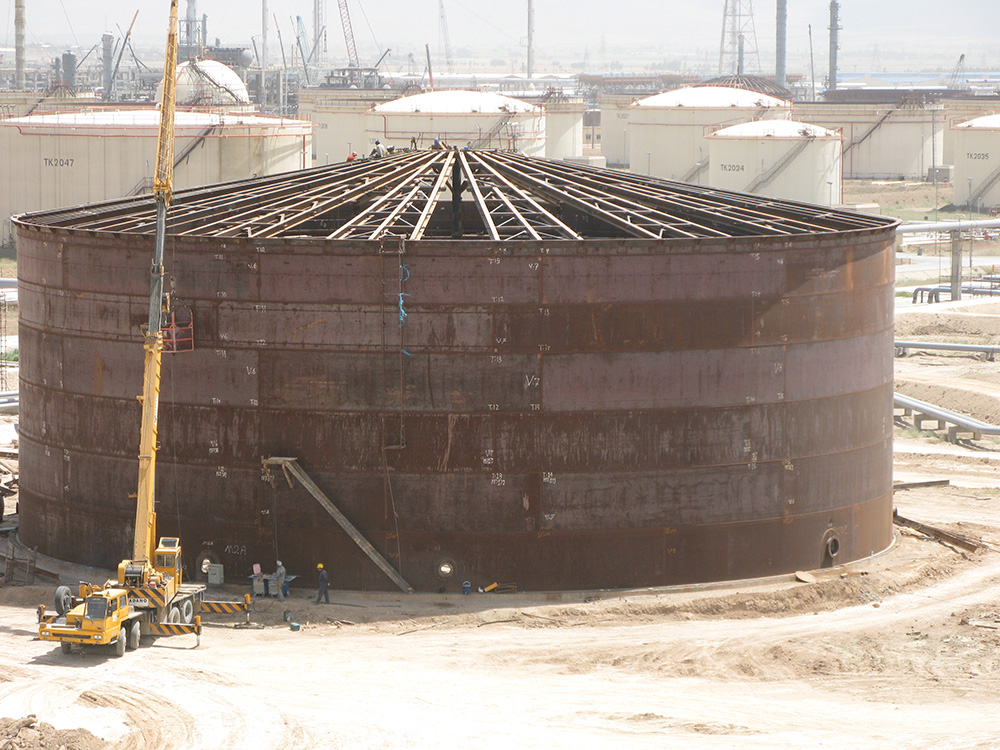

Storage tanks are a critical component of the oil, gas, and petrochemical industries, and their safe maintenance is essential to prevent accidents and potential damage. Proper repair practices, strict adherence to safety requirements, and appropriate tank preparation play a major role in improving operational efficiency and protecting personnel. This guide explains the procedures for in-service maintenance and taking tanks out of service, along with safety considerations and tank preparation steps, to ensure that maintenance activities are carried out with minimum risk and maximum efficiency.
In-Service Maintenance
When a tank is in service and requires maintenance, the feasibility of performing repairs while the tank remains in operation depends entirely on the tank type and the nature of the stored material. In-service maintenance can generally be reviewed under the following conditions:
1. Pressurized Tanks
Products stored in pressure vessels are typically toxic and flammable. Therefore, while the tank is in service, any hot work on any part of such tanks is strictly prohibited. In special cases, and only with strict safety considerations, certain cold work activities may be permitted.
For example, cold work on valves or tank nozzles may be allowed. If a safety valve installed on the roof of a fixed roof tank is found to be out of its set point, the operator must first fully close the inlet valve. After ensuring complete safety, the safety valve is removed and the opening is blinded, ensuring that no leakage is present. The safety valve can then be sent to the mechanical workshop or valve shop for repair. After repair and calibration, the valve is returned to site and reinstalled in its original position.
2. Atmospheric Storage Tanks
Depending on the type of stored product, atmospheric storage tanks are classified into three categories:
Non-flammable and Non-toxic
Maintenance activities on these tanks are relatively simple. Minor hot and cold work may be carried out after the required technical and safety inspections and upon issuance of the necessary permits. Typical examples include water or dilute brine storage tanks, where even direct contact between personnel and the stored material does not pose a hazard.
Non-flammable but Toxic
Examples include caustic storage tanks and similar materials. Minor repair work may be carried out provided that there is absolutely no risk of contact between the stored material and maintenance personnel.
Flammable
Any hot work on these tanks while they are in service is strictly prohibited. Cold work is limited to minor defect correction only. Before starting such work, maintenance personnel must carefully follow all safety procedures and personal safety requirements. Upon completion, the work must be approved by technical inspection.
Typical minor repairs include tightening bolts and nuts to eliminate leakage at manholes. In some cases, a gasket at a manhole or nozzle may leak, allowing liquid to escape from the tank. In such situations, bolts may be retightened with extreme caution. Over-tightening must be avoided, as uneven pressure may rupture the gasket and worsen the leakage. If tightening does not resolve the issue, it may be necessary to drain the tank and perform more extensive repairs.
In all cases involving flammable materials, a fire extinguisher must always be readily available at the work site. Activities such as tightening bolts must be performed carefully to prevent spark generation.
Taking the Tank Out of Service for Maintenance
Before starting maintenance work, the tank must be prepared in a way that ensures personnel and equipment safety while minimizing hazards associated with the stored materials. Performing the following steps in sequence and with strict attention significantly reduces the risk of accidents and damage.

Initial Actions and Coordination
- Notify the unit or department supplying the product so that product transfer to the tank is stopped.
- Coordinate with safety, fire protection, maintenance, and instrumentation departments.
Draining Tank Contents
- Drain the tank contents as much as possible using available pumps and piping.
- After draining, disconnect all lines except the drain line and blind them outside the tank using blind plates.
- If the tank is equipped with a cathodic protection system, disconnect the tank from the system before separating flanges to prevent sparking.
- Loosen and remove all manhole bolts on the tank shell, leaving only two bolts per manhole in place.
Water Filling and Preparation for Cleaning
- To facilitate removal of remaining materials at the tank bottom, introduce water into the tank through wash lines or filling lines.
- Never pour water from a high elevation onto the liquid surface, as this may generate static electricity.
- If required, flexible hoses may be used to introduce water through manholes.
- A critical safety point during this operation is ensuring that the metal end of the hose is properly grounded to the tank shell.
Air Exhaust and Electrical Safety
- Open one of the roof manholes and install an air exhaust fan equipped with a grounding cable.
- Grounding is essential to prevent static electricity buildup and potential explosions. Perform this task with the minimum number of personnel necessary, while ensuring that additional personnel remain nearby for emergency assistance.
- Always minimize the number of people in hazardous areas to reduce potential casualties and improve emergency response effectiveness.
Purging Operations in Floating Roof Tanks
- In floating roof tanks, purging is carried out by opening one of the side manholes located below the floating roof.
- To purge the space above the floating roof, a worker wearing a respirator enters the tank and opens the floating roof manhole.
Personnel Safety Precautions
- Personnel climbing up or down tank stairs must remove their gloves and maintain direct contact with metal surfaces to ground their bodies and prevent static electricity buildup.
- Once the air exhaust fan is positioned, all personnel must leave the tank roof and the dike area before starting the fan.
- After approximately 15 minutes, personnel may re-enter the dike area. This precaution is necessary due to the potential release of toxic vapors and the risk of explosion.
Gas Testing and Ventilation
- Until the tank is officially declared gas-free, no one is permitted to access the tank roof while the exhaust fan is operating.
- Open the shell manholes.
- Continue ventilation until the concentration of flammable gas inside the tank is reduced to less than 20% of the Lower Explosive Limit (LEL). For example, if the LEL of propane in air is 40%, the gas concentration inside the tank must not exceed 8%.
- Continue ventilation while simultaneously agitating and removing bottom sludge using high-pressure water.
- Ensure that the water hose nozzle is grounded.
- Remove water using pumps or allow it to drain through designated openings.
- In floating roof tanks, the roof must be fixed at a height that allows personnel to enter the space beneath it for cleaning or repair if necessary.
Authorization for Maintenance Personnel Entry
- Before issuing entry permits, gas testing must be conducted at all opened locations and on the tank roof.
- Maintenance personnel may be allowed to enter the tank without an oxygen mask for cold work only if:
- The flammable gas concentration is below 20% of the LEL.
- All connected pipelines are positively isolated using blind plates.

Hot Work with Steam
- If hot work is to be performed outside the tank, steam must be introduced into the tank through one of the manholes.
- Hot work is permitted only when steam is observed exiting from all tank openings.
Final Notes
- Clearly identify the minimum required actions at the beginning of the work.
- Tank out-of-service procedures are not identical under all conditions.
- Minor shell repairs differ significantly from major floating roof overhauls.
- Minimize the frequency of taking tanks out of service whenever possible.
- During maintenance, related systems such as electrical and instrumentation equipment should also be inspected to reduce potential future issues.