

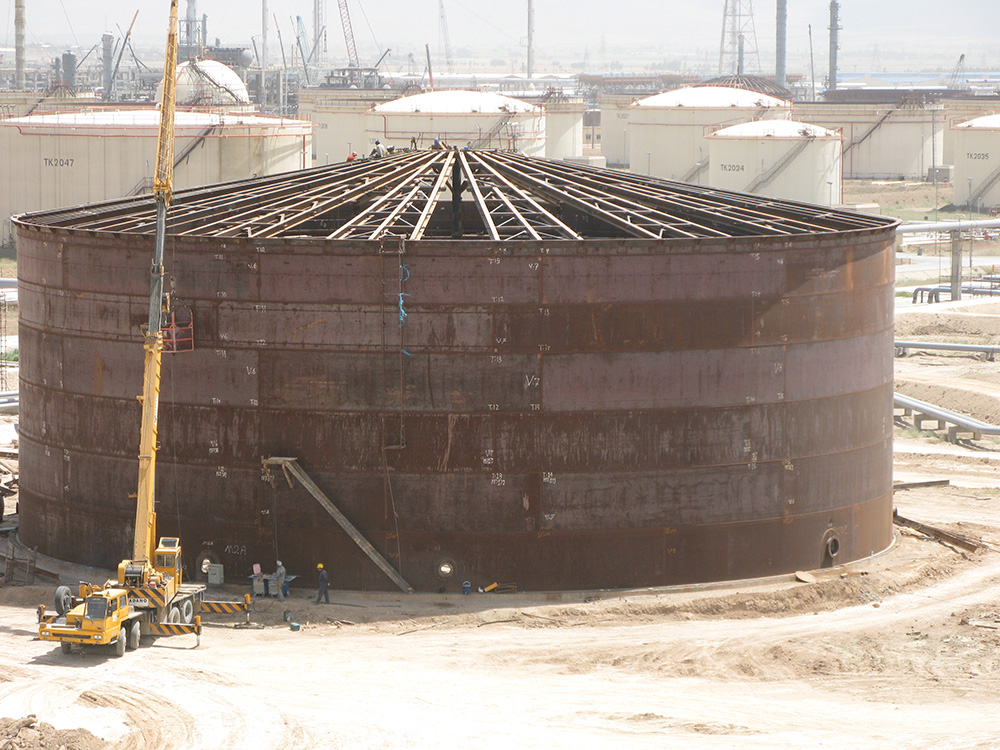
In the design and construction of storage tanks and pressure vessels, determining the appropriate shell thickness is one of the most critical parameters. This thickness is essential not only for maintaining structural integrity under internal loads, but also for ensuring long-term safety, preventing leakage, and avoiding sudden failures. Shell thickness calculations depend on several factors, including design pressure, material properties, tank dimensions, and applicable international standards. This article reviews the design principles, methods for determining shell thickness, influencing factors, and commonly used standards in tank engineering.
Importance of Shell Thickness in Tanks and Pressure Vessels
In pressure vessels, internal pressure generates hoop stress and longitudinal stress in the vessel shell. Hoop stress is usually the dominant stress and serves as the primary criterion for shell thickness calculation. Incorrect selection of shell thickness can lead to plastic deformation, leakage, cracking, and even explosion. Therefore, accurate design of storage tanks and pressure vessels with appropriate shell thickness is essential to ensure the safety of personnel, the environment, and equipment.
Engineering studies show that even minor differences in wall thickness can significantly affect the safety performance and service life of a tank. Consequently, every design must be based on design pressure, material properties, and service conditions.

Factors Affecting the Determination of Tank Shell Thickness
Internal Pressure:
Internal pressure is the most important factor in determining shell thickness. ASME BPVC Section VIII defines a direct relationship between internal pressure and wall thickness. As pressure increases, wall thickness must be increased accordingly.
Material Type and Properties: The type of steel or alloy used has a direct impact on thickness selection. Materials with higher allowable stress, such as alloy steels, allow for reduced thickness compared to conventional carbon steels without compromising safety. Proper material selection establishes a balance between safety and cost.
Corrosion and Environmental Factors: For storage tanks and pressure vessels exposed to corrosive fluids or environments, additional thickness is considered as corrosion allowance. This ensures that even with gradual wall thinning, the tank remains safe during its service life.
Tank Dimensions and Geometry: The diameter and shape of the tank—such as cylindrical or spherical—affect stress distribution and required shell thickness. Tanks with larger diameters require greater thickness to withstand the same pressure. Spherical tanks, due to uniform stress distribution, can usually withstand the same pressure with less thickness.
Calculation Formulas and Design Standards
ASME BPVC Section VIII
For cylindrical pressure vessels, shell thickness is determined using the following formula:
t = (P × R) / (S × E − 0.6P)
where:
- t = minimum required thickness
- P = design pressure
- R = internal radius
- S = allowable stress of the material
- E = weld joint efficiency
This formula clearly illustrates the direct relationship between internal pressure and shell thickness and forms the basis of pressure vessel and tank design calculations.
API 650 for Storage Tanks
For low-pressure liquid storage tanks, API 650 determines shell thickness based on liquid height and hydrostatic pressure. In this method, shell thickness may vary along the height of the tank to withstand the pressure exerted by the liquid column.
API 620
For storage tanks operating at medium to relatively high pressures, API 620 recommends greater shell thickness to ensure safety against internal pressure and service conditions.
Conceptual Example of Thickness Calculation
According to ASME standards, as internal pressure increases, shell thickness must increase proportionally. For example, when designing a pressure vessel with a given internal radius and high operating pressure, the standard formula shows that the required thickness increases nearly linearly with pressure, while materials with higher allowable stress can safely withstand lower thickness.
Effect of Weld Efficiency and Corrosion
In design formulas, the factor E represents weld joint efficiency. Full-penetration welds with an efficiency of 1.0 allow the effective thickness to be close to the calculated value, whereas welds with lower efficiency require additional thickness.
To mitigate long-term corrosion effects, the calculated design thickness must be increased by adding the corrosion allowance, resulting in a final safe and manufacturable thickness.
Thickness Testing and Inspection
After fabrication, the tank shell thickness must be inspected using non-destructive methods such as Ultrasonic Thickness Testing (UT) and other NDT techniques to verify compliance with the design thickness. Periodic inspections help identify corrosion or wall thinning due to service conditions in a timely manner.
This practice is recommended by many recognized standards and is critical for ensuring the safe performance of tanks.
Conclusion
Determining the appropriate shell thickness for storage tanks and pressure vessels is a precise, multi-factor engineering process that must be based on design pressure, material properties, tank geometry, service conditions, and applicable standards. The use of standards such as ASME BPVC, API 650, and API 620 provides a reliable framework for safe design.
Considering additional factors such as corrosion allowance, weld quality, and inspection programs plays a vital role in extending service life and enhancing tank safety. Adherence to these principles helps prevent technical, financial, and human losses and ensures sustainable and safe operation of industrial tanks.
References:


