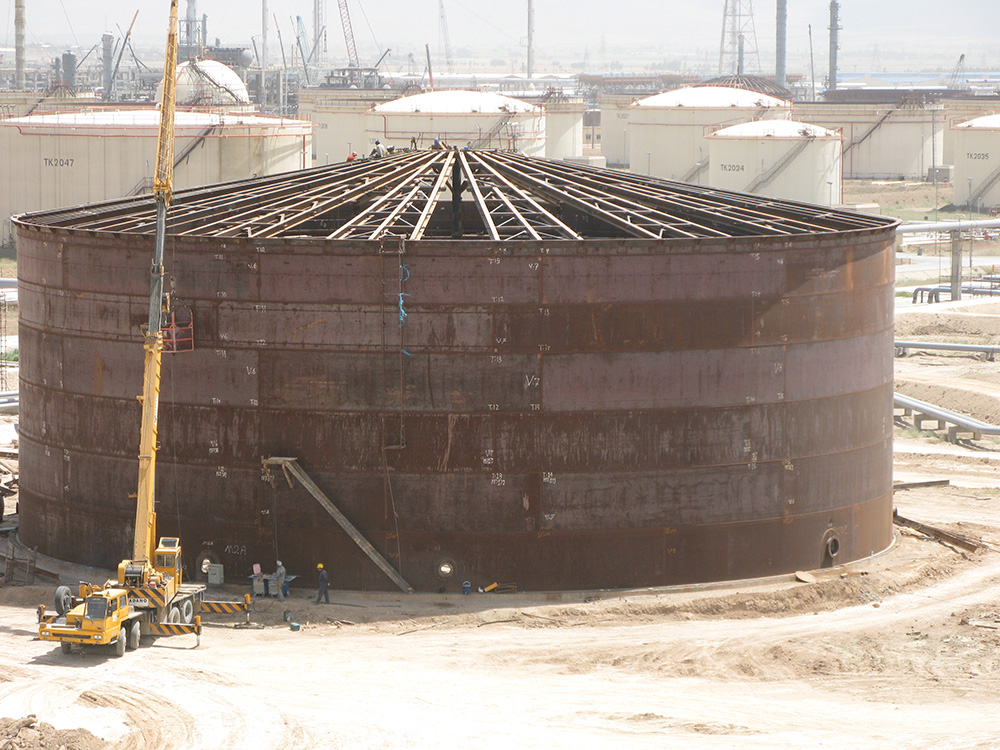

Storage tanks are widely used across various industries, including oil, gas, petrochemical, agriculture, and chemical sectors. These tanks play a vital role in storing and protecting liquids and semi-solid materials, and selecting the appropriate type of tank based on the stored material’s characteristics is a key principle of industrial safety and efficiency. Choosing the right tank type and adhering to safety guidelines not only prevents accidents but also increases productivity and reduces operational costs.
Open tanks are among the simplest yet most practical types of storage tanks, suitable for storing materials with specific characteristics. This article examines their features, applications, advantages, limitations, and importance in industrial storage processes.
Definition and Features of Open Tanks
Open storage tanks are the simplest type of storage vessels, constructed with walls but no roof. They are primarily suitable for materials that:
- Have low volatility: Highly volatile materials evaporate quickly due to direct contact with air, leading to losses.
- Are non-flammable: Without a roof, exposure to the environment increases the risk of fire for flammable materials.
- Are not high-value or require strict purity: Direct exposure may result in contamination. However, if materials are treated before use or purity is not critical, open tanks are practical.
These tanks are generally large, with diameters ranging from 5 to 70 meters and depths from 2 to 7 meters or more. Tank construction materials depend on the stored substance and can include steel, concrete, metal, or even low-cost materials.
Applications of Open Tanks
Open tanks are mainly used for materials that require simple storage conditions, such as:
- Water and brine: For chlor-alkali plants or desalination units.
- Chemical fertilizers and slurries: Including phosphate and potash fertilizers.
- Non-volatile, non-flammable industrial solutions: Fluids used in chemical processes or temporarily stored before transfer to production units.
One of the simplest types of open tanks is ponds, which are dug into the ground and made of inexpensive materials. The floor is often clay, as low permeability prevents fluid leakage. Practical applications include seawater evaporation for salt production.
Advantages and Limitations of Open Tanks
Advantages:
- Low construction cost: Simple design and lower requirements for durable materials reduce expenses.
- High capacity: Tanks can be large in diameter and depth to store significant volumes.
- Easy access and maintenance: Open design allows for inspection, cleaning, and repairs.
Limitations:
- Evaporation and material loss: Volatile materials cannot be stored.
- Environmental contamination: Exposure to dust, birds, and other pollutants.
- Unsuitable for flammable or high-value materials: Risk of fire or contamination.
Design and Material Selection for Open Tanks
Material choice depends on the stored substance and environmental conditions:
- Steel: For corrosion-sensitive materials.
- Concrete: For high-capacity tanks requiring structural strength.
- Low-cost/earth materials: For ponds or inexpensive storage, such as water in salt evaporation processes.
Tank dimensions and design should allow easy filling, emptying, and maintenance. Diameters up to 70 meters and depths up to 7 meters or more are feasible.

Importance and Safety Considerations for Open Tanks
Due to direct exposure to the environment, safety is critical in the design, construction, and maintenance of open tanks to prevent leaks, contamination, and other hazards. Key measures include:
- Choosing a suitable location: Minimizes contamination risk and environmental hazards.
- Impermeable flooring: Prevents leakage and contamination.
- Monitoring walls and connections: Ensures structural safety and reduces risks from cracks or corrosion.
- Level and wall alignment control: Maintains material quality and structural safety.
To reduce evaporation and losses, it is recommended to store low-volatility materials or use vapor control systems if necessary. For chemical or sensitive materials, monitoring pH, temperature, concentration, and tank floor condition is essential.
Maintenance of Open Tanks
Regular and preventive maintenance is crucial for safety and tank longevity, including:
- Inspecting and repairing floors and walls
- Checking for leaks or structural damage
- Removing sediments and accumulated slurries
- Monitoring liquid levels and inlet/outlet systems
These actions also minimize risks from corrosion or mechanical stress.
Comparison of Open Tanks with Other Tank Types
Open tanks are simpler and more cost-effective than pressure vessels but are limited in storing volatile or flammable materials. Fixed-roof or floating-roof tanks are better suited for sensitive or high-value materials, reducing contamination and evaporation risks. Tank selection should consider the stored material’s characteristics, environmental conditions, and budget.
Conclusion
Open tanks are among the simplest and most economical storage tanks, suitable for non-volatile, non-flammable, moderately valuable materials. Proper design, adherence to safety guidelines, and regular maintenance are key to safe and efficient operation. Selecting the appropriate material, floor, and tank dimensions can improve productivity, extend service life, and prevent human and financial losses.